Friday, November 22, 2019

My husband won’t lose weight and I don’t want sex any more

DEAR DEIDRE: MY husband promises he will lose weight but never does.

I am fed up and losing interest in sex.

 My husband refuses to lose weight and I am tired of his excuses

1

My husband refuses to lose weight and I am tired of his excusesCredit: Getty - Contributor

Get in touch with Deidre today

Got a problem?

Send an email to problems@deardeidre.org. Every problem gets a personal reply, usually within 24 hours weekdays.

You can also send a private message on the DearDeidreOfficial Facebook page.

Follow me on Twitter @deardeidre.

He was a bit overweight when we met 18 years ago but he's piled on the weight since and it affects our family life.

He has never taken the kids swimming and his snoring is now so bad I can't sleep. He is 37, I am 34.

He says he hates being overweight, but he quickly gives up on diets or exercising.

He only managed once to get to his normal weight for his height.

I told him he looked good and our sex life was brilliant. But slowly the weight piled back on.

I have tried ignoring it, nagging him, and pleading with him. Now I give up.

DEIDRE SAYS: The roots of his eating issues are likely to go back to his childhood.

Maybe food was a reward or substitute for feeling loved when he was growing up.]

DEAR DEIDRE I'm having steamy sex with my hot lover but I feel sad for her poor husband

CARE SCARE I fear my sons will be taken into care as they don't shower at their mum's house

DEIDRE'S PHOTO CASEBOOK Ryan is humiliated as he meets guys Candy had threesome with

MONEY MISERY I am being hounded by a debt collector and it's stressful - how do I stop it?

SEX LIES I feel lied to by my ex who now says he's pansexual as we're about to share a flat

IS IT ME? Is my fiancée snappy or am I being insecure after she cheated on me?

DEAR DEIDRE I had mind-blowing sex with my girlfriend's sister... and I want it again

DEAR DEIDRE My fiance snogged his best man on the stag do and it's ruined my big day

DEAR DEIDRE I had sex with three men & now I'm pregnant but my fella thinks the baby's his

GHANA REGRET IT My webcam girl from Ghana is special but my mum says she's after my money

Tell him you fear for his long-term health.

Put the emphasis on the whole family getting healthier rather than focusing on him dieting.

My e-leaflet End Weight Worries tells how to enjoy eating and still maintain a healthy weight.

NEXT IN TODAY'S DEAR DEIDRE Should I tell my new partner I had an STD four years ago? READ DEIDRE'S PHOTO CASEBOOK Candy's threesome guys get her fella down the pub for a drink Strictly's Neil Jones cringes as he's forced to relive ex Katya's affair thanks to judge Motsi Mabuse's clumsy comment

Thursday, November 21, 2019

Average US BMI on the rise despite increasing weight loss efforts

Despite the increasing number of people in the United States who say that they are trying to lose weight, the average body mass index (BMI) of U.S. adults is on the rise.

man runningShare on PinterestMore and more people are trying to lose weight, but few actually do.

This is according to new research appearing in the journal JAMA Network Open.

Dr. Lu Qi, director of the Tulane University Obesity Research Center in New Orleans, LA, is one of the corresponding authors of the study.

As per the study paper's title, the research examined "[t]rends in self-perceived weight status, weight loss attempts, and weight loss strategies among adults in the United States" in 1999â€"2006.

Dr. Qi and team used nationally representative data from nine applications of the National Health and Nutrition Examination Survey (NHANES) between 1999 and 2016.

In total, they had access to data from 48,026 participants. The researchers examined trends in measured BMI and weight, self-reported weight during the past year, and the difference between measured weight at present and self-reported weight in the prior year.

Two contradicting trends

The study demonstrated that the proportion of participants who tried to lose weight increased over the study period, despite the fact that current weight and weight in prior years had increased.

Specifically, the number of adults who said that they had tried to lose weight rose from 34% to 42% in 1999â€"2016. During this time, the most common weight loss strategies the participants applied were eating less, exercising more, and drinking more water.

U.S. adults also reported changing their eating habits, such as "consuming less sugar, candy, and sweets" and eating less junk food or fast food.

However, despite these efforts, the "trends for actually measured weight and self-reported weight history increased during the same time period," the study authors write.

In fact, if 33.7% adults had obesity in 2007â€"2008, this number jumped to 39.6% in 2015â€"2016.

This suggests, the study authors explain, that the weight loss strategies "may not have translated into effective weight loss," even though studies show that these strategies should be effective.

"These findings," says Dr. Qi, "suggest that although 34â€"42% of U.S. adults in our study reported weight loss efforts, many of them might either not actually implement weight loss strategies or apply a minimal level of effort, which yielded unsatisfactory results."

Sticking to weight loss strategies is key

In other words, U.S. adults hoping to lose weight would need to apply more effort, particularly in terms of adherence. "Reduced food consumption is one common strategy to lose weight, but modified diets are difficult to maintain," says Dr. Qi.

"These findings suggest a need to increase the promotion of effective strategies for weight loss, including caloric reduction and increased physical activity, among all adults attempting to lose weight," she adds.

"Notably, adherence is the primary factor predictive of a successful response to a weight loss attempt. Therefore, weight loss strategies that consider a participant's preferences and abilities may help them stick with it long-term."

Dr. Lu Qi

The researchers also mention the possibility that the contradiction in trends is down to the fact that the participants who tried to lose weight were not those who may have needed to.

Conversely, those who might have needed to lose weight for health reasons may not have tried very hard to do so because they considered their weight to be "normal."

In fact, the number of people who thought they were "approximately the right weight" also increased over the 15 year period, report the researchers.

Potential study limitations

The researchers acknowledge some other potential limitations to their study. Firstly, participants self-reported the data on weight self-perceptions and weight loss efforts, which makes the information subject to potential bias.

However, the study authors say that the difference between how the participants reported their current weight and their measured weight was minimal, indicating that their approximations may have been correct.

Secondly, the NHANES surveys did not collect information on the "frequency, duration, or number of weight loss attempts or strategies."

Finally, and importantly, the study could not establish causality or temporal relationships in the observed trends.

7 healthy ways to break through a weight-loss plateau

a woman preparing food in a kitchen: Feel like you've been working hard, eating well but all of a sudden the weight doesn't seem to be budging anymore? Here are seven expert tips to help you break through that weight loss plateau. © Getty Images Feel like you've been working hard, eating well but all of a sudden the weight doesn't seem to be budging anymore? Here are seven expert tips to help you break through that weight loss plateau. You've completely integrated your workouts into your weekly routines, you've perfected the art of meal prepping, but all of a sudden the weight you've seen steadily melt away doesn't seem to be budging anymore.

Our bodies are very good at adapting, so while during the first few weeks of change – if you've suddenly introduced regular exercise and a healthier diet – you likely saw weight drop easily off as your body adapted, however, once your body got used to the new normal, it started to get comfortable, resulting in a weight loss plateau.

So how do you get unstuck?

a woman holding a glass of red wine: If you've suddenly hit a speed-bump in your weight-loss journey, there are a few healthy things you can try. (Image: Getty) © Provided by Bauer Media Pty Ltd If you've suddenly hit a speed-bump in your weight-loss journey, there are a few healthy things you can try. (Image: Getty) Certified health and wellness coach Mandi Green says there are several ways you can break through a weight loss plateau, explaining there a few questions you can ask yourself about your food, activity and work-life balance, that can help you identify where you can make small, healthy changes.

Here, Mandi shares her top seven tips to help you work through your plateau and it could be as simple as drinking more water.

1. Ditch the booze

Mandi says that although alcohol is relatively low in carbs and calories – think wine, vodka and tequila, a 2005 study published in the Critical Reviews in Clinical Laboratory Sciences journal showed that alcohol can suppress fat-burning capabilities and may lead to more fat around your belly.

While not all belly fat is necessarily bad, visceral fat – fat that is stored within the abdominal cavity – can actively increase the risk of some serious health problems such as type 2 diabetes, heart diseases and strokes, due to its proximity to your vital organs.

Gallery: 7 Things Doctors and Nutritionists Wish You Knew About Fasting and the Warrior Diet (Best health)

The study also showed the body prioritises metabolising alcohol before any food you've consumed, "which means that until the alcohol has burned, no other food will be," Mandi explains.

Adding, "Because alcohol lowers your inhibitions and alters decision-making, we tend to overeat when drinking. All these things are working against your weight loss and contributing to your plateau."

2. Cut back on carbs and add more veggies

Mandi suggests cutting back on your carb intake and instead loading up on fibre-rich veggies, making them around 75 to 80 per cent of your daily food intake.

Then, add in some protein, healthy fats such as coconut and olive oil and avocado, and round it out with smaller servings of grains like brown rice and quinoa.

a woman looking at the camera: Keeping your workout routine varied throughout the week can help you push through a weight-loss plateau. (Image: Getty) © Provided by Bauer Media Pty Ltd Keeping your workout routine varied throughout the week can help you push through a weight-loss plateau. (Image: Getty) 3. Change up your workout

As mentioned above, your body is incredibly adaptable and can quickly adjust to new forms of exercise or a new diet if you repeat it for long enough, so the trick is to change things up, in particular, your fitness routine.

Mandi suggests a combination of strength training and cardio to "maximise your time and optimise your fat burning and muscle building."

She says you want each workout to be just as challenging as the first workout was – even as you become stronger.

Mandi says she always suggests for her clients to go to an Orangetheory Fitness class, which is essentially a group fitness HIIT (high intensity interval training) class based around the science of excess post-exercise oxygen consumption (EPOC), which has been found to elevate your metabolism and help you burn calories even up to 36 hours after you complete your workout.

4. Keep a food (and feelings) journal

While you may think you're keeping to your healthy eating regime, there may be a few extra spoonful's of things that slip through the cracks, Mandi says.

She suggests keeping a food journal of everything you eat, but most importantly, what you're thinking or how you're feeling at that moment.

a person sitting on a bed: Mandi suggests keeping a journal of not just the food you eat, but also the emotions you're feeling throughout the day. (Image: Getty) © Provided by Bauer Media Pty Ltd Mandi suggests keeping a journal of not just the food you eat, but also the emotions you're feeling throughout the day. (Image: Getty) "I have my clients write down what they were thinking or feeling when they went to reach for the chips or the chocolates," Mandi explains.

"It doesn't need to be a lot of writing, just a one-word feeling. The most typical answers I hear are: bored, stressed, frustrated, overwhelmed, sad, lonely, and felt obligated socially."

For example, going out to eat and everyone else is eating dessert, or that they felt obligated to prepare unhealthy food because of an obligation to family.

Once written down, it can give you great insight into when and why you're reaching for the unhealthier choices, making you aware of emotional cues, that next time you can pick up on in the moment.

Gallery: 20 resolutions we almost always break (Espresso)

5. Get seven to nine hours of shut-eye

There has been a wealth of research on sleep recently and for very good reason – it's one of the most important factors for good health. The problem is, most of us aren't getting enough of it.

"Lack of sleep causes your body to release extra cortisol (stress hormone), and has been proven to slow your metabolism and leave you at an increased risk of obesity and metabolic syndrome," Mandi says.

In turn, a spike in cortisol signals to your body to conserve more energy in your waking hours therefore, your body will hang on to fat instead of using energy to burn it.

Mandi adds, "A lot of times we'll think we're hungry when actually we're sleepy. This is often the culprit in the evening."

Mandi says when working with clients she's found that as they stop snacking at night and stick to earlier bedtimes, weight loss naturally kicks back into action.

a woman wearing a hat: Yup, water can help with weight-loss too. (Image: Getty) © Provided by Bauer Media Pty Ltd Yup, water can help with weight-loss too. (Image: Getty) 6. Up your water intake

Not only does water help us feel fuller for longer, but it is also a natural weight loss aid, Mandi says.

In a small study conducted by Humboldt-University in Berlin and published in the Journal of Clinical Endocrinology and Metabolism, it was shown that drinking just 500ml of water increases our metabolism and calorie burn by up to 30 per cent for up to 1.5 hours.

"Additionally, your body is made up of 75 per cent water," explains Mandi.

"When you are even slightly dehydrated, your body will pull water from nonessential functions, like digestion, to utilise it for essential functions like lung, liver, heart and muscle function.

"So if you're dehydrated, you're not losing weight."

7. Reduce stress or find a way to manage it

Just as a lack of sleep spikes your cortisol levels, so too does high stress, fast-paced lifestyles, which also affects your body's ability to respond to insulin, a hormone which helps keep your body's blood sugar levels from getting too low or too high, and uses sugar from carbohydrates (glucose) to use as energy or store for future use (as fat).

So, if you're stressed for long periods, your body will be more likely to hold onto fat, resulting in that weight loss plateau.

Cortisol also prohibits the release of oxytocin, explains Mandi, which is the feel-good hormone that helps us shift into the 'rest and digest' parasympathetic nervous system.

Getting the aforementioned seven to nine hours of sleep a day, checking your work-life balance and taking time out to breath, meditate or exercise are all good ways to help manage and relieve stress.

a woman lying in the legs of a person sitting on a sofa: Check your work-life balance, get plenty of rest and take time out to yourself and exercise to help manage and relieve stress. (Image: Getty) © Provided by Bauer Media Pty Ltd Check your work-life balance, get plenty of rest and take time out to yourself and exercise to help manage and relieve stress. (Image: Getty) While there are plenty of tips to help you push through a plateau, Mandi stresses that "it's always important to remember that the best way to lose weight naturally and keep it off permanently is to inspire your body to shift metabolically by getting yourself very healthy through foods, activities, thoughts and lifestyle choices.

"Weight loss then becomes a natural result," Mandi says.

It's also good to keep in mind that the number on the scales (and your BMI) is not always the most accurate indicator of how 'healthy' you are.

As accredited dietician, eating disorder and mindful eating specialist Christina Turner told Now To Love previously, the scales can't distinguish between fat, muscle or bone mass – so if you've been building up that muscle and losing fat with regular exercise, the scales could go up as muscle is denser than fat.

That's why it's always important to remember that as long as you're getting plenty of movement in and eating a fresh, balanced diet and getting plenty of sleep, you're likely already on track to a happier, healthier you.

Wednesday, November 20, 2019

Briana And Ryan Culberson Just Shared A Photo Of Their 128-Pound Weight Loss

© Instagram Briana Culberson, daughter of The Real Housewives of Orange County's Vicki Gunvalson, and her husband Ryan Culberson are practically spokespeople for the keto diet. The two have been steadily documenting their keto-fueled weight loss—and Ryan just shared another update on Instagram.

"Smiles from a couple that's down a combined 128 pounds!" he captioned a sweet photo of the couple posing together in the woods. "No fads, workouts, or magic pills just a consistent Keto lifestyle!"

Ryan and Briana first talked about doing keto in November 2018, when Ryan referred to Briana as a "keto queen" on Instagram. He noted that they'd been on the diet for five months at that point.

Fast forward to January 2019, and Briana posted on Ryan's Instagram that she'd lost 45 pounds on the diet. She also said that keto "greatly improved" her health. (Briana was diagnosed with lupus in 2016 and almost had to have her leg amputated in 2018 due to her condition, according to People.)

In March 2019, the couple revealed on Instagram that they lost 86 pounds together in eight months on the diet. "Celebrating being 86 pounds lighter between the two of us!" he captioned the shot. "What are you waiting for?"

And in July, the two shared that they were 107 pounds lighter on keto. "Happy 4th of July from my family to yours!" Ryan captioned a shot of himself, Brianna, their kids, and her stepfather Donn. "Swipe right and see the difference a year on keto has made, down 107 between the two of us!"

Ryan and Briana have also offered up little snippets of advice here and there including how it's possible to stay on the keto diet at Disneyland (JIC you were wondering… ).

So, yeah, they're now an amazing 128 pounds down. It's not hard to see why they're into keto.

Slideshow: 50 foods the world's healthiest women eat every day (Provided by Prevention) 

If weight loss is your only goal for exercise, it’s time to rethink your priorities

As an aesthetic society, we often demonise body fat and stigmatise people with lots of it. There's often an assumption that people carrying excess weight don't exercise and must be unhealthy.

But that's not true: you can be fat and fit. In fact, as we age, low levels of fitness can be more harmful to our health than high amounts of fat.

Read more: Interactive body map: physical inactivity and the risks to your health

For those considering starting exercise, try looking beyond weight loss for motivation. No matter how much you weigh, there are always benefits to exercise.

Exercise actually does a pretty poor job of getting us to expend enough excess energy to lose weight. This is partly due to a compensatory effect of our appetite, which increases after we exercise.

Exercise changes our body composition – how much fat we have as a ratio to how much lean (muscle) tissue we have – but this doesn't always cause big changes on the scales.

Here are just five ways exercise improves our health, no matter how much we weigh.

1. Better cardiorespiratory fitness

Cardiorespiratory fitness is a measure of how far and hard you can run without needing to stop, or how many stairs you can climb without being out of breath. Running for longer, or climbing more stairs, means you have a higher absolute cardiorespiratory fitness which cannot be improved with weight loss alone.

Having a high body mass index (BMI) may reduce the absolute intensity you can exercise but it doesn't mean it is less effective.

You may be able to jog between every third lamppost, for example, but not run consistently for 1 km. While it may seem the periodic jogging is not as impressive, it's all relative to your baseline and any exercise is better than none.

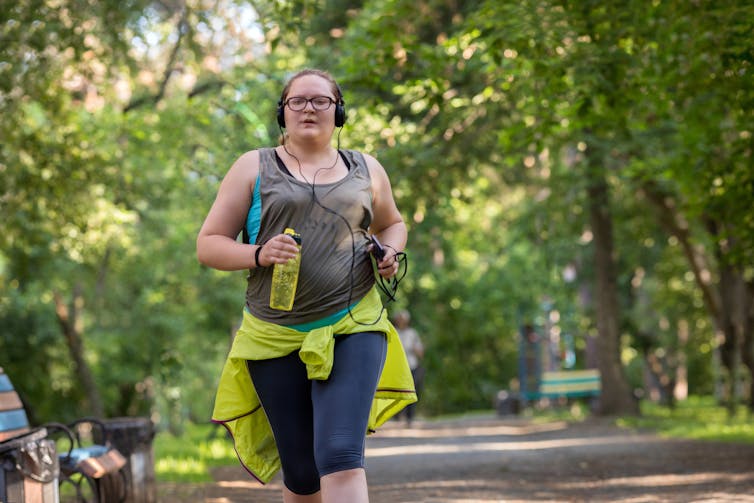
You don't have to run the whole time to improve your fitness. Demkat/Shutterstock

If you're carrying a lot of excess weight, you might prefer non-weight bearing exercise such as swimming or cycling indoors to minimise stress on your joints – but this will depend on you and what you like doing. After all, you're more likely to continue exercising if you enjoy it.

If you're thinking "but I hate running/swimming/cycling/dancing and I'd rather lift weights", then lift weights! Although lifting weights doesn't have the same effects as cardio training, the benefits are still as important for mobility, joint function and maintaining muscle mass as we age.

Read more: Don't have time to exercise? Here's a regimen everyone can squeeze in

2. Lowered risk of heart disease and stroke

Exercise reduces the risk of heart disease and stroke, even in those with a chronic disease such as diabetes, irrespective of body fatness.

Regular exercise helps lower blood pressure, improves delivery of blood throughout the body, and reduces inflammation, even in those with a high body mass index.

3. Reducing the 'bad' fat

Exercise improves our body's ability to use energy. We store large amounts of energy as fat, which is quite hard to break down, as it costs a lot of oxygen compared to "cheaper" fuels for the body to use like glucose.

But when we exercise regularly, we increase our body's ability to use fat as a fuel source as well as requiring more energy at rest.

This doesn't necessarily mean more exercise equals more fat loss, but it does mean more fat turnover, and typically less fat stored in and around the organs (the "bad" visceral fat).

Read more: Belly fat is the most dangerous, but losing it from anywhere helps

4. Mental health benefits

Research has consistently shown that people who exercise (regardless of body size and shape) have better mental health and lower levels of stress, depression and emotional problems.

It does this via blood flow to the brain, increased release of endorphins that make us feel happy, and by helping to moderate the brain's response to stress.

Often, the hardest part is getting started with exercise or going to perform the exercise, but once you are moving the mental health benefits begin.

People who exercise have better mental health. Africa Studio/Shutterstock 5. Preventing weight gain

While exercise may not help us lose a lot of weight on the scales, it's a good way to keep weight off and prevent weight regain.

Regular exercise continues to encourage the body to use stored fuels and remodel tissues (such as muscle) to grow healthier and stronger.

But preventing weight regain is tough. People who have lost weight may need greater amounts of exercise to counteract the physiological drive to return to the heavier body weight.

Read more: Genes, joules or gut bugs: which one is most to blame when it comes to weight gain?

If you need some extra help getting started or finding a routine that suits you, talk to your GP or consider seeing an accredited exercise physiologist.

Tuesday, November 19, 2019

12 Fasting Tips That'll Help You Actually Lose Weight (And Not Go Crazy)

Let's face it: Following a diet can be tough. Following one that involves fasting (yes, as in not eating)? Well, that can be even tougher. And for some (*raises hand*), just the idea of purposely missing a meal is enough to make them hangry, if not worse.

Yet, there are plenty of folks out there who are up for the challenge—not to mention have even seen some serious results from a structured and scheduled eating plan. So what's the secret to their success? Following at least one—if not all!—of these 12 tips for acing a fasting diet, straight from nutritionists. But first...

Remind me again: What is intermittent fasting, exactly?

Essentially, intermittent fasting (IF) is a type of eating plan that involves periods of fasting—during which you can consume only water, coffee, and tea—and eating—when you can generally eat what you like. Such freedom to choose your own chow is one of the many reasons the diet's racked up so many fans, including stars like Vanessa Hudgens and Halle Berry.

And in a world where many of the top trending diets involve a lot of, well, math, IF stands outs for being fairly simple to understand. "It doesn't require counting calories, macros, or measuring ketones. You can eat most anything you want between a specific window of time, although most programs recommend eating healthfully when you do eat," Sonya Angelone, RD, a spokeswoman for the Academy of Nutrition and Dietetics, previously told Women's Health.

Need some IF inspo? Halle Berry is a huge fan—find out why and how she does it:

Another pro? There isn't a one-size-fits-all plan or "right" way to do this, per Anglone. In fact, it's just the opposite. There are many different kinds of fasting or IF schedules to choose from, so you can decide the diet that best fits your lifestyle. Here are a few popular picks:

  • The 16:8 diet: Eat whatever you want (read: no calorie counting!) for eight hours a day and fast for the rest.
  • The 5:2 diet: Eat normally for five days a week and cut back to 20 percent of your normal daily calories for the other two "fasting" days, which usually involves about 500 calories for women.
  • The 14:10 diet: Similar to the 16:8 method, but you fast only 14 hours and eat for 10, making it easier to follow but not necessarily easier to lose weight.
  • And that, dear class readers, is Fasting 101. Now, onto lesson number two: the 12 must-know tips to do a fasting diet safely and successfully.

    1. Ease into your new eating plan.

    While it might be tempting to jump right into your new eating routine (the initial excitement is real), doing so can be difficult and leave you with increased hunger and discomfort, according to Michal Hertz, RD, a dietitian in New York City. Instead, she recommends starting slowly by, say, doing two to three days of IF during the first week and then "gradually increasing week to week." Taking thing slow isn't just a great fasting tip, but a great tip for life (just sayin').

    2. Know the difference between needing to eat and wanting to eat.

    Once you hear your stomach growl, it can feel like there's no way you'll get through X more amount of hours without food. Tune in to that hunger cue. "Ask yourself whether the hunger is boredom or actual hunger," says Eliza Savage, RD, a registered dietitian at Middleburg Nutrition in New York City. "If you're bored, distract yourself with another task." (That 200-email-deep inbox of yours might be a good place to start.)

    'I Tried Intermittent Fasting For A Week'

    If you're truly hungry but not feeling weak or dizzy (which are signs, btw, that you should stop fasting ASAP), then sip a warm mint tea, as peppermint is known to reduce appetite, or drink water to help fill your stomach until your next meal, per Savage.

    Now, if you've been trying IF for awhile and still feel extreme hunger between periods, then you need to do some thinking. "You need to either add more nutrient- or calorie-dense foods during your eight-hour period, or consider that this may not be the best plan for you," Hertz says. Adding healthy fats such as nut butters, avocado, and coconut and olive oils, as well as proteins, during eating times can help keep you stay satisfied and full longer.

    3. Eat when necessary.

    Technically, intense hunger and fatigue shouldn't happen when following the 16:8 fasting method (perhaps the most common one), according to Hertz. But if you do feel extremely lightheaded, listen up, as odds are your body's trying to tell you something. You likely have low blood sugar and need to eat something—and, repeat after me, that is okay.

    By definition, fasting involves removing some, if not all, food, so don't beat yourself up for breaking your fast with small—and smart!—bites. Your best bet? Go for a protein-rich snack like a few slices of turkey breast or one to two hard-boiled eggs (to help remain in a ketogenic (fat-burning) state), Savage recommends. You can then return fasting, that is, of course, if you feel up to it.

    4. Hydrate, hydrate, hydrate.

    Even when you're fasting, drinking water and bevvies like coffee and tea (sans milk) are not just allowed, but, especially in the case of H2O, encouraged, per Hertz.

    She recommends setting reminders throughout the day and particularly during fasting periods to lap up plenty of liquids. Aim to fill up on at least 2, if not 3, liters per day, according to both Hertz and Savage.

    5. Break your fast slowly and steadily.

    After spending several hours food-free, you might feel like a human vacuum ready to suck up whatever's on your plate. But chowing down in minutes is actually no bueno for your body or your waistline, according to research. Instead, you want to chew well and eat slowly to allow your digestive system to fully process the food, Savage explains. This will also help you have a better idea of your fullness so that you steer clear of overeating.

    6. Avoid overeating.

    On that note, just because you've stopped fasting doesn't mean you should feast. Not only can eating too much leave you bloated and uncomfortable, but it can also sabotage the weight-loss goals that likely led you to IF in the first place. Simply put: It's not necessarily how much is on your plate that can help you stay full for longer but what is on your plate. Which brings me to the next fasting tip...

    7. Maintain balanced meals.

    Having a hearty mixture of protein, fiber, healthy fats, and carbs can help you ultimately shed those pounds and steer clear of extreme hunger when fasting. A good example, per Savage? Grilled chicken (you want about 4 to 6 oz of protein) with half of a small sweet potato, and sautéed spinach with garlic and olive oil.

    When it comes to fruits, you want to opt for those with "a low-glycemic index, which are more slowly digested, absorbed, and metabolized, causing a lower and slower rise in blood glucose," Hertz explains. A stable blood-sugar level helps you avoid cravings—and thus is key when it comes to successfully dropping lbs.

    8. Play around with different time periods.

    While Hertz mostly recommends the 16:8, she says to a look at your general lifestyle to see which fasting method might fit best.

    What Is The Best Intermittent Fasting Schedule?

    For example, if you're an early riser, Hertz suggests eating during the earlier hours, like 10 a.m. to 6 p.m., and then fasting until the following morning at 10. Remember: The beauty of IF is that it's easily amendable and flexible to fit you and your schedule.

    Another option, according to Savage, is cutting yourself off earlier and eating breakfast later each day to gradually grow your fasting strength. "We all naturally fast once daily—while we sleep—so maybe you practice 'shutting down the kitchen' earlier." For example, "close" the kitchen at 9 p.m., and then don't eat again until breakfast at 8 am. That's a natural 11-hour fast! Slowly move those times out (e.g. kitchen closes at 8 p.m., breakfast at 9 a.m.), if desired, she says.

    9. Steer clear of 24-hour fasts.

    Both experts do not recommend fasting for a full day, as it can "lead to increased weakness, hunger, and increased food consumption—and thus, weight gain," Hertz explains.

    If your goal is to lose weight, then considering your overall caloric intake and working on scaling that down might be more beneficial than toughing out a fast for a long time (especially if you're the type to binge after). Just take it from research, which shows that there actually aren't more benefits in fasting for 24 hours versus daily caloric restriction, Savage adds.

    10. Adapt your workout routine.

    First thing's first: You can most definitely exercise if you're doing a fasting diet. But (!!) you want to be mindful of what types of movement you do, and when. "If you're choosing to exercise in a fasting state, I would recommend exercising first thing in the morning, when you may have the most energy," Savage says.

    All Your FAQs About Fasted Cardio—Answered

    Is It Safe To Fast If I Work Out A Lot?

    That said, it's important to remember that if you're not, in Savage's words, "adequately fueling your muscles," then you're at a greater risk of injury. So you might want to consider lower-impact workouts, such as yoga or steady-state cardio, on fasting mornings and save that hard-core HIIT class for after you've eaten.

    11. Keep track of your journey.

    Believe it or not, maintaining a food journal can help you with your fasting diet. A food journal for fasting?! Yup, you read that right. While you might not be chronicling as many eats, actively jotting down details like any emotions and symptoms (hunger level, any weakness, etc.) that come up during IF can help you gauge your progress, Savage says. (It might also help you notice any trigger points that make fasting harder on you, like drinking the night prior.)

    12. Listen to your body.

    This. Is. Important. Keep an eye out at all times for symptoms such as dizziness, fatigue, (unusual) irritability, headache, anxiety, and difficulty concentrating. If you experience any of these, consider breaking your fast. "These are all signs that the body is going into starvation mode and may need nourishment," Savage says. And if you start to feel colder than normal, that is even more of a sign to stop fasting, she adds.

    That said, be patient. It'll likely take your body time to get used to fasting, and you may feel hungrier and weaker than usual. So don't flip out if you have these (less serious) sensations for a week or so. If these challenges last longer, however, and you experience symptoms like the ones above dizziness, Savage recommends ditching the diet and finding something else to help you meet your goals. No amount of pounds is worth getting sick over—trust.

    Elizabeth Bacharach Elizabeth Bacharach is the Assistant Editor at Women's Health where she writes and edits content about mental and physical health, food and nutrition, sexual health, and lifestyle trends across WomensHealthMag.com and the print magazine.

    High-protein diets may be dangerous for people trying to lose weight

    High-protein diets are trendy right now, but they may not be healthy. According to a new expert editorial, substituting the majority of carbohydrates with protein is hard on the kidneys, something that's particularly risky among the morbidly obese and individuals who have diabetes. At the core of the matter are people who are unaware they're at higher risk when they start the diet.

    A high-protein diet often involves consuming meat, eggs, cheese, and other foods that contain a notable amount of protein, but low levels of carbohydrates. Patients who need to lose a lot of weight, particularly as part of their disease management, may be advised to eat a low-calorie, low-carbohydrate, high-protein diet in order to rapidly lose weight.

    This diet may be most risky in overweight individuals, however, particularly if they have diabetes, a condition that often includes low-grade chronic kidney disease, according to the researchers behind the new editorial. A high-protein diet may trigger glomerular hyperfiltration, the researchers note, as well as various types of kidney disease.

    Professor Denis Fouque, one of the three researchers who penned the warning, explained, "To put it in a nutshell: To recommend a high-protein diet to an overweight diabetes patient may indeed result in loss of weight, but also in a severe loss of kidney function. We want one, but we also get the other."

    The elderly, individuals who only have one kidney, obese people, anyone with diabetes, and others are at a particular risk of "ringing the death bell for their kidney health" by eating a high-protein diet, according to Fouque.

    The editorial comes alongside a pair of newly published studies that analyze the topic. Of particular concern, in this case, are people who are unaware they have mild kidney disease, therefore putting them at risk by adopting what they may think is a risk-free diet.

    Love Is Blind 's Kelly Chase Reveals the Secret Behind Her Weight Loss Transformation

    Love Is Blind star Kelly Chase is revealing the blood, sweat and tears that went into her epic physical transformation.  The health and ...